The William Cullen Bryant Homestead
207 Bryant Road, Cummington, Massachusetts 01026-9639
413/634-2244 bryanthomestead@ttor.org
www.thetrustees.org
House and Grounds
Grounds are open year-round, daily, sunrise to sunset.
Guided tours of the house are offered last weekend in June
through Columbus Day on selected days. Allow a minimum
of 1 hour, 2-3 hours if taking house and/or Rivulet Trail tour.
Facilities
Open seasonally; vistor center, gift shop, and public
restrooms. Picnic tables year-round.
Events
Annual Craft Festival, 3rd weekend in July, Biennial Christmas
Event, 1st weekend in December; call for other programs.
Private Functions
Call for arrangements.
 |
 |
Travel Directions
From the intersection of Rts. 9 and 112 in Cummington, take Rt.
112 south up the hill for 1.5 mi. to a five-way interesection. Continue straight
onto Bryant Rd. for 0.2 mi. to entrance and parking (25 cars) behind red barn. |

Conserving the Massachuestts Landscape Since 1891 |
The William Cullen Bryant Homestead is
owned and cared for by the Trustees of Reservations, a member-supported nonprofit
conservation organization that preserves, for public use and enjoyment, properties
of exceptional scenic, historic, and ecological value in Massachuetts, and
works to protect special places across the state.
Join us! For membership information, please call 978/921-1944 or visit our web
site at www.thetrustees.org. |
| ©2002 The Trustees of Reservations |
|
THE WILLIAM CULLEN BRYANT HOMESTEAD
Cummington, Massachusetts

Photo © B.Girardi
Lines on Revisiting the Country. 1825
"I stand upon my native hills again,
Broad, round and green, that in the summer sky
With garniture of waving grass and grain,
Orchards, and beechen forests, basking lie....
Here I have 'scaped the city's stifling heat,
Its horrid sounds and its polluted air...
Am come awhile to wander and to dream."
William Cullen Bryant
|
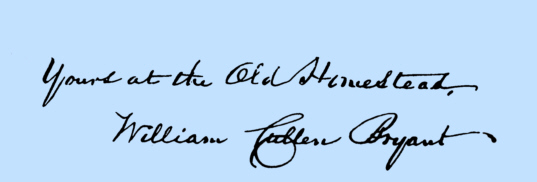
WILLIAM CULLEN BRYANT
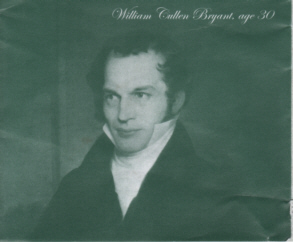
William Cullen Bryant, born November 3, 1794, astonished the literary world with the publication
of his first major poem at age 13. Most of his poetry drew inspiration from the Cummington
countryside surrounding the Homestead. In 1817, "Thanatopsis," Bryant's most famous
poem, was published while he practiced law in Great Barrington MA.
After his marriage to Frances Fairchild, the family moved to New York City in 1825 where
the poet and former lawyer began a career as editor; first at literary publications and
eventually as editor-in-chief and publisher at the New York Evening Post. He held this
position for the rest of his life.
In 1834 Bryant embarked on the first of many lengthy trips, traveling widely in the U.S.
and taking seven trips abroad. Many of his exotic travel mementos are now at the Homestead.
Famous as a publisher and editor; Bryant's public life involved him on many fronts as a
politician and conservationist, leading to the creation of New York City's Central Park.
Artists of the Hudson River School considered Bryant their muse. At his death in 1878,
Bryant was an iconic figure. His fame was so widespread that the centennial of his birth
in 1894 drew thousands of people to the Homestead to celebrate his life and accomplishments.
 |

THE WILLIAM CULLEN BRYANT HOMESTEAD
Located on a hillside overlooking the Westfield River Valley, the Homestead is on the site
of the original Cummington community founded in 1762. The Town Meetinghouse was constructed
near what is now the five-corner intersection of the Homestead in 1782. Seven years later
it was moved and a schoolhouse, which Bryant attended, was erected on the site. Cummington's
center shifted to the valley and as the community grew, Bryant's father; Dr. Peter Bryant,
served as physician and in the state legislature.
Cummington's population diminished after 1840, since many townspeople, like Bryant's family,
abandoned their farms and moved westward. As Bryant observed "the soil is now exhausted;
the fields...are turned into pastures...and the land which once sufficed for two farms
now barely answers for one." Woodlands, a source of fuel and building materials, were
also depleted.
In 1865, 30 years after the Homestead was sold out of the family, Bryant purchased his former
boyhood home and used it as a summer retreat from late July through early September for
the remainder of his life. Year-round the house was occupied by a series of caretakers
and their families.
Bryant remained deeply committed to his childhood community and made a number of significant
contributions to Cummington. He donated $500 to build a new schoolhouse located near the
Homestead. A larger gift was a library, complete with book collection and a librarian's
residence. These two structures remain on the south intersection of Routes 9 and 112. To
make access easier to the Library from the Homestead, Bryant paid for a road that later
became part of Route 112. He also built a road to West Cummington from the Homestead that
is still in use today.
|
1. PIONEER SUCCESSIONAL FOREST
An area once farmed and then abandoned around 1930
2. MATURE FOREST
Beech, maple, and hemlock trees dominate pine and birch
trees
3. OLD-GROWTH FOREST
A forest not significantly disturbed by human actions.
Characteristics include a wide spectrum in age distribution
of its
trees and a high percentage of trees that approach a maximum
height for each species.
4. PIT AND MOUND TOPOGRAPHY
Undulating forest floor, characteristic of old-growth forests.
Mounds result from organic matter accumulating over decaying
tree trunks, stumps, and uplifted roots. Pits are cavities
left by
uplifted roots or empty spaces between fallen trees. |
5. RIVULET STREAM & SURROUNDING HABITAT
The Rivulet supports a diversity of animals, insects, and
plants.
6. EASTERN HEMLOCK (TSUGA CANADENSIS)
A shade-tolerant tree, characteristic of older forests. This
one
is about 300 years old.
©R. CHEEK
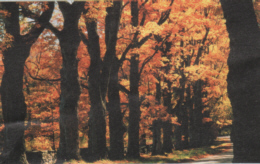
Maple Tree Allee, near the pond, leading
to the Rivulet trail |
7. WILD BLACK CHERRY
(PRUNUS SEROTINA)
This 102.4 foot black cherry
is the second tallest of its
species known in
Massachusetts.
8. WHITE ASH
(FRAXINUS AMERICANA)
White ash requires sunlight to regenerate.
It usually does not live beyond 300 years.
9. STANDING DEAD
TREES OR SNAGS
Snags provide a micro-
habitat for fungi, mosses, and
lichens, eventually attracting
insects that provide food for
birds and small mamamals. |
Bryant bought the forest as a
conservationist, and stated that
it should never be cut down, but
should be preserved. His
appreciation of the beauty and
life within forests and nature
became a main theme of many
of his poems. He even wrote a
poem especially about this
brook and forest, titled "The
Rivulet."
|
10. HEMLOCK-DOMINATED STAND
Ancient, giant hemlocks create a cathedral
effect with
an under story.
11. AMERICAN BEECH (FAGUS GRANDIFOLIA)
A shade tolerant tree retaining its characteristic
thin,
smooth, gray bark throughout its life and
often dominant
in mature forests.
12. SUGAR MAPLE (ACER SACCHARUM)
The maple thrives in shady forest undergrowth
but shoots up
when the forest canopy opens and allows
sunlight to enter.
13. YELLOW BIRCH (BETULA ALLEGHENIENSIS)
A common member of the northern hardwood
forests.
Many have reached their maximum life expectancy
of 300
years.
14. OLD GROWTH HARDWOOD AREA
Sugar maples, yellow birch, and white ash
trees that range
from 300 to 400 years old.
15.a. PINE FOREST
Although not old growth, this area boasts
trees of 150 to 175
years old. Two pines in this area are 150
feet, among the
tallest in the state. |
|
15.b. WHITE PINE (PINUS STROBUS)
White pine seedlings outcompete many other tree species
seedlings, frequently invading abandoned fields.
16. IRONWOOD OR HORNBEAM (OSTRYA VIRGINIANA)
A slow-growing, short-lived tree that is shade tolerant
as a
young seedling but requires increasing sunlight as
it ages.
17. DISTURBANCE AREA
When trees fall, the forest canopy opens, allowing
sunlight
to reach the forest floor resulting in a dramatic increase
of
under story growth amoung herbaceous plants and small
trees.
©M. Arduser

The Rivulet |
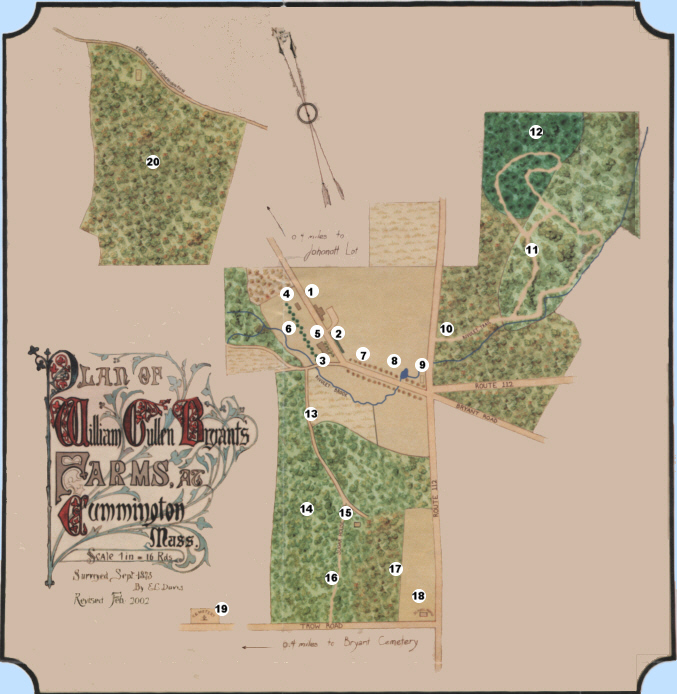
1. BARN
The original barn was built in 1801 by William Cullen
Bryant's father, Dr. Peter Bryant. When the property
was
purchased by Welcome Tillson in 1835, the new owner
built
a new barn, possibly using materials from the original
structure. Barn additions, including stables, were
made in
1866 and 1875 by William cullen Bryant. In 1880, his
daughter, Julia, added a section to the north for apple
storage. The last addition and restoration to this
structure
was made in the 1930s by his great grandson, Conrad
Goddard. Sincethat time, the southwest section added
by
Bryant was removed.
2. HEMLOCK HEDGE
Hemlock hedges were used around the house as natural
fences. This hedge marked the end of the pasture and
the
edge of the road in front of the house.
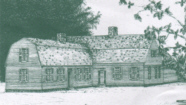
3. HISTORIC HOUSE
The original house was either built or remodeled by
Ebenezer Snell, William Cullen Bryant's maternal
grandfather, when he purchased the property in 1789.
Dr.
Peter Bryant added a two-room office in the front,
and a
kitchen and wood house in therear in 1801. In 1842,
Welcome Tillson removed the office addition. When Bryant
re-purchased the family home in 1865, he converted
it to a
three-story summer residence by raising the first floor,
expanding the house northward, and replacing his father's
office on a smaller scale. His daughter, Julia, made
additional
external changes. Few changes have been made since
then.
The current historic house is painted in the colors
that were
used in 1870.
4. CARETAKER'S COTTAGE
In 1931, Conrad Goddard built a caretaker's residence
across from the red barn ending the caretaker's year-round
residence in the main house. the Caretaker's Cottage
is now
used as staff housing for the Trustees of Reservations.
5. FIVE MAPLES
Sarah and Peter Bryant had seven children; five boys
(Austin, William Cullen, Cyrus, Arthur, and John Howard)
and two daughters (Sarah and Charity Louise). Five
maples
were planted by the family in the early 19th century
to
represent the five sons. these trees are now estimated
to be
nearly 200 years old. They are nearing the end of their
natural life cycle and will soon have to be replaced.
6. PINE WINDBREAK
Bryant planted a pine windbreak behind the house in
the
1860s to shield it from the winds coming across the
pastureland. The original pines grew to such a height
that
they endangered the historic house during windstorms.
They
were replaced with the exisiting trees in the 1990s
and now
look much as the original trees did when Bryant first
planted
them.
7. MAPLE TREE ALLEE
The maple trees along the drive were planted by the
Bryants
around the time the family planteed thefive maples
honoring
their sons. They, too, are nearing the end of their
life cycle,
since they are close to 200 years old
8. POND
At the urging of his youngest brother, John Howard,
Bryant
built this pond in 1866 to serve as an ice source for
the
Homestead. Currently, the pond is used by the Cummington
Fire Department as a water source.
9. BRYANT'S SCHOOL HOUSE
Site of Cummington's First Meetinghouse
The Town Meetinghouse was constructed near what is
now
the five-corners intersection of the Homestead in 1782.
Seven years later it was moved and a schoolhouse, which
Bryant attended, was erected on the site.
10. RIVULET TRAIL
This trail traversing the site of the old growth forest
runs
close to the Rivulet Brook that provided water for
the
Homestead. The area served as inspiration for Bryant's
poem,
The
Rivulet, 1824
"....As pure thy limpid waters run,
As bright they sparkle to the sun;
As fresh and thick the bending ranks
Of herbs that line thy oozy banks..."
|
11. OLD-GROWTH FOREST
An old-growth forest (also referred to as an original,
or
primary growth, forest) is one that has not
been significantly
disturbed by human actions. It is an example of what
a
forest would become after thousands of years of evolution
through the interactions of climate, plants, animals,
and
natural disturbances. Since humans evolved and began
cultivating the earth, very few old-growth forests
exist,
especially in new England. This small area contains
trees
greater than 200 years of age, and provides a wonderful
sample of undisturbed forests.
12. WHITE PINE STAND
This white pine stand contains trees close to or topping
150 ft.
in height, which is a rarity in New England. This is
especially
unusual since the trees are relatively young at 120-170
years.
Because of their height, this stand is considered to
be on of
the top ten white pine stands in the eastern United
States.
13. ENTRANCE TO WOODS
The entrance to the Homestead woods inspired Bryant's
poem,
Inscription
for the Entrance to a Wood, 1817
"...enter this wild wood
And view the haunts of Nature. The calm shade
Shall bring a kindred calm, and the sweet breeze
That makes the green leaves dance, shall waft a balm
To thy swee heart...."
14. SUGAR BUSH
for over 200 years, the
maple trees in this area
were tapped to provide
maple syrup. In her diaries,
Sarah Snell Bryant
comments repeatedly about
the "boys[William Cullen
and his brothers] tapt [sic]
the sugartrees. The trees
are still being tapped, and
the syrup is available for
purchase at the Homestead. |
 ©R CHEEK
Tapping the Maples along the Allee |
15. SITE OF SUGAR HOUSE
The Sugar House was used to boil the sap into maple
syrup
and existed until the late 20th century. It fell into
disrepair and
was dismantled by the Trustees of Reservations.
16. SUGAR HOUSE TRAIL
This trail leads through thesugar bush and past the
Sugar
House site.
17. REMNANT APPLE ORCHARD
Bryant used the Homestead lands to plant many pear
and
apple orchards, directing his caretakers to plant specific
varieties. His mother and brothers established a very
successful nursery in Princeton, IL, and the entire
family was
involved in apple and pear production. This part of
the
property contains a small remnant of one of many orchards
present on the property during Bryant's time.
18. SCHOOLHOUSE SITE
In 1872 Bryant donated $500 to build a schoolhouse
located
near the Homestead on the corner of Trow Road and Route
112. The schoolhouse building was moved and is currently
on
another property near the Homestead.
19. BRYANT CEMETERY
Bryant's maternal grandparents, Ebenezer Snell and
Sarah
Packard Snell, as well as his fater, Peter Bryant,
are buried in
This early Cummington cemetery. Bryant and his wife,
Frances, were buried at his Long Island estate, Cedarmere.
20. JOHONOTT LOT
This section of the property was purchased by Ebenezer
Snell
in 1773. There is a cellar hole and two gravesites
that inspired
Bryant's poem,
The
Two Graves, 1826
"Tis a bleak wild hill, but green and bright
In the summer warmth and the mid-day light;...
And fresh from the west is the free wind's breath;
There is nothing here that speaks of death. ...
Yet there are graves in this lonely spot
Two humble graves, - but I meet them not.
I have seen them, - eighteen years are past
Since I found their place in the brambles last..." |


 Pay Taxes Online